
WHAT SETS IT OFF · SCREENS
Screens get blamed for a great deal of headache and eye strain. They deserve some of it — but not for the reason almost everyone assumes. Blue light is close to irrelevant. Duration and height are not.
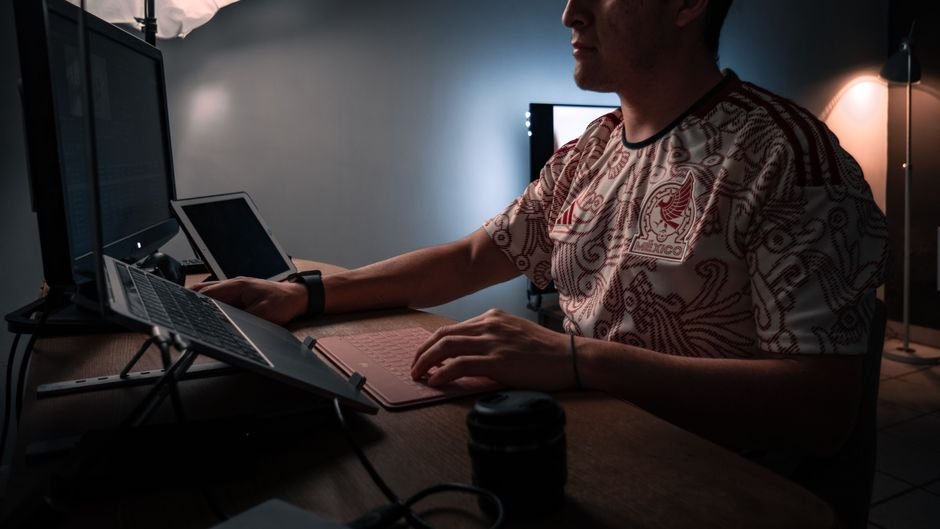
What the evidence actually supports
The blue-light story is weak. Filters and tinted glasses have not shown convincing benefit for headache. And the wavelength argument falls apart on one fact: daylight holds far more blue light than any monitor.
What does hold up is plain. First, you blink less, which leaves eyes dry and irritated. Second, your eyes keep focusing hard at one close distance (accommodative effort). Third, and most of all, you hold your head and neck in one fixed position for hours. The third has the largest effect, and it is not an eye problem at all.
THE ADJUSTMENTS THAT ACTUALLY MOVE IT
- Monitor height — top of the screen at or slightly below eye level. A low laptop screen is the most common single finding in this whole group.
- Position changes — the fix for a duration problem is duration, not posture. Move every 30 to 45 minutes.
- Distance — roughly an arm’s length, with text big enough that you do not lean in. Leaning in is what loads the neck.
- Deliberate blinking and room humidity for the dry-eye part.
- An eye test if this is new. An uncorrected or outdated prescription is a real and easily fixed cause.
Why “20-20-20” underdelivers
The rule — every 20 minutes look 20 feet away for 20 seconds — deals with eye focus and dry eye. It does nothing at all about head position, which is the biggest factor. A break where you stand and move beats one where you look across the room while frozen in the same posture.
Where the screen is a proxy rather than a cause
Long screen days correlate with the things that actually raise headache frequency. Those are late finishes and late sleep, late or skipped meals, and less movement. So screen time keeps showing up in people’s diaries as a trigger. What it really marks is a day shaped a certain way. Two biological drivers sit under that — unsteady blood sugar (glucose) and sleep debt. The third is a meeting or production schedule that decides when you eat and when you stop.
That is worth knowing because it changes the plan. Blue-light glasses treat a mechanism that is largely not there. Raising the monitor and protecting meal and sleep times treats the ones that are.
Frequently asked questions
Do blue light glasses help headaches?
The evidence is weak. If they help you, no harm done. But they are not the step with the best payoff here.
Why do I get headaches only on work days?
That weekly shape usually points at holding one position for a long time, not at the screen itself — the working-day pattern.
Should I get my eyes tested?
If this is new, yes. An outdated prescription or uncorrected astigmatism is a real and cheap thing to rule out.
Is screen glare a factor?
Mildly. Set the screen at a right angle to windows. Avoid working with a bright window behind the monitor.
The related pages
Raise the monitor before buying the glasses
It is free, it addresses the largest contributor, and it is the change most people have never been told to make.
12174 Natural Bridge Rd, Suite 304
St. Louis, MO 63044
Next to DePaul Hospital, off the I‑270 and I‑70 junction, west of the airport.
Sources
- Roy S et al. Increased screen time and its association to migraine and tension-type headache: a cross-sectional investigation among Bangladeshi students. BMJ neurology open, 2024. PubMed 38736585
- Langdon RL et al. Screen time and pediatric headache: A scoping review of the literature. Headache, 2024. PubMed 38299747
- Kantar Y et al. Smartphone Screen Time, Sleep Quality, and Headache in Young Adults Presenting to the Emergency Department: A Case-Control Study. Healthcare (Basel, Switzerland), 2026. PubMed 42651426
- Lund J et al. Headache in Children and Adolescents: The Association between Screen Time and Headache within a Clinical Headache Population. Neuropediatrics, 2022. PubMed 34905787